Wednesday, November 17, 2010

Polynomial Equations

A polynomial equation is an equation that can be written in the form

    axn + bxn-1 + . . . + rx + s = 0,
where a, b, . . . , r and s are constants.
We call the largest exponent of x appearing in a non-zero term of a polynomial the degree of that polynomial.

Examples
1. 3x + 1 = 0 has degree 1, since the largest power of x that occurs is x = x1. Degree 1 equations are called linear equations.
2. x2 - x - 1 = 0 has degree 2, since the largest power of x that occurs is x2. Degree 2 equations are also called quadratic equations, or just quadratics.
3. x3 = 2x2 + 1 is a degree 3 polynomial (or cubic) in disguise. It can be rewritten as x3 - 2x2 - 1 = 0, which is in the standard form for a degree 3 equation.
4. x4 - x = 0 has degree 4. It is called a quartic.

The polynomials name is depend on their degree of exponents. There many names of in the polynomials. The names are following below:
Name 1: Degree 0- constant.
Name 2: Degree 1- linear.
Name 3: Degree 2 – quadratic.
Name 4: Degree 3 – cubic.
Name 5: Degree 4 – quadratic.
Name 6: Degree 5- quintic.
Name 7: Degree 6 –sex-tic.
Name 8: Degree 7 - degree with number terms.

End Behavior

Domain - x values
Range - y values referred to as f(x)

  • domain → +∞, range → +∞ (rises on the right)
  • domain → -∞, range → -∞ (falls on the left)

  • domain → -∞, range → +∞ (rises on the left)
  • domain → +∞, range → -∞ (falls on the right)

  • domain → +∞, range → +∞ (rises on the right)
  • domain → -∞, range → -∞ (falls on the left)

  • domain → +∞, range → +∞ (rises on the right)
  • domain → -∞, range → -∞ (falls on the left)

Thursday, October 7, 2010

Indentify Quadratic Functions

Standard form: ax² + bx + cy² + dy + e= 0
If a=c, then the equation is a circle.If you have an equation like 5x² + 5y²=25 
If a or c, are different signs the equation is a hyperbola. Like this equation 2x² - 2y²= 6
If  a can NOT = c, and they are the same signs then the equation is an ellipse.  this equation would look like  4x² + 2y²= 25
If a or c= 0, then  the equation is a parabola. it would look something like this 2x² + 4y= 3.

Circle


Ellipses


Hyperbole


Parabola

Multiplying Matries

You can only multiply two matrices together if the number of columns in the first matrix are the same as the number of rows in the second matrix. You can then write your dimension statement. 2(rows) x [3(columns) times 3(rows)] x 4(columns). The number of columns and the number of rows are the same so that means you are able to multiply these two matrices. After multiplying the rows by the columns you then take the sum of the products.

Example;

Tuesday, September 14, 2010

Dimensions of a Matrix

In a matrix, it is organized ROW x COLUMN. Row are horizontal and columns are vertical.

 
 This matrix is 1x 3 because there is 1 row and 3 columns.


 This matrix is 3 x 3 because there is 3 rows and 3 columns.


 This matrix is 3 x 2 because there is 3 rows and 2 columns.


This matrix is 3 x 3 because there is 3 rows and 3 columns.

Friday, September 10, 2010

Errors !

The equation is actually y=2x+9. You can figure this out simply by plugging in a (x,y) represented in the table and it would not work. The slope is not 10 because the y's go up by 10 and the x's go up by 5. Thinking of rise over run, 10/5 is reduced to 2.

The student did not plug the coordinate into the second equation. When you plug it into the second it does not work so it is not a solution.


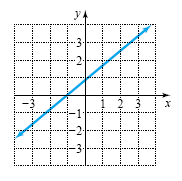
The problem in this is that the first graph's line is suppose to be dotted. The second graph is suppose to be shaded above.


The slope line on number 20 should be dotted and on number 21 should be shaded below.

Wednesday, September 1, 2010

How to graph absolute functions

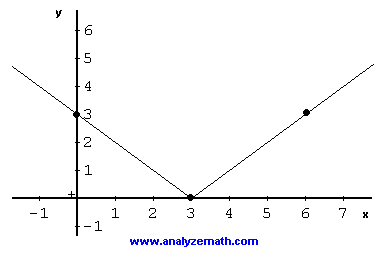
The parent function is y=a|x-h|+k. The vertex is (h,k). So if the function was y=|x-9|+1, then the vertex would be (9,1) But if inside the absolute value sign it said 'x+9' then the vertex would be (-9,1). The 'h' controls the shift from left or right on the graph. The 'a' controls if the 'V' shape it the function makes is open up or down and the slope (vertical stretch or horizontal shrink). The 'k' controls the up or down postion of the function. So if you wanted to graph y=|x|+2 it would look like this..


And if you wanted to graph y=|x-3| it would look like this...

System of Equations


Consistent Independent- The two lines intersect at one point (x,y). One solution.


Inconsistent Dependent- The two lines have the same slop but different y-intercepts and they never cross. No solutions.


Consistent Dependent - The two lines have the same slope and y-intercept. All solutions.